Product Overview
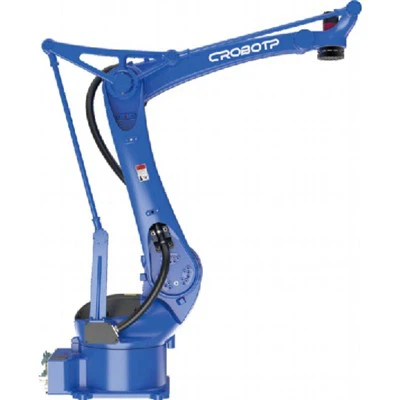
The CRP-RA26-220 is a six-axis industrial robot designed for material handling applications requiring a maximum payload of 220 kg and a reach of 2650 mm. Its ground-mounted installation and specified joint travel ranges provide a basis for planning heavy-workpiece transfer between production stations.
For equipment builders and industrial manufacturers, selection should consider more than payload alone. Workpiece dimensions, gripper weight, center of gravity, pickup and placement positions, and s
Key Design Considerations
220 kg Maximum Payload
The robot's rated maximum payload is 220 kg. When assessing a heavy-workpiece application, account for the end-of-arm tooling and the complete load arrangement, then confirm that the proposed setup falls within the robot's applicable loading limits.
01
2650 mm Maximum Reach
A maximum reach of 2650 mm provides a reference for planning transfers across machine openings, fixtures, and adjacent stations. The actual reachable positions depend on robot mounting, joint limits, tool orientation, and surrounding obstacles.
02
Six-Axis Movement
Six axes allow the robot to change the position and orientation of the end effector. This is relevant to handling tasks where a workpiece must be approached, lifted, rotated, or placed in different orientations within the robot's working envelope.
03
Defined Joint Travel and Speed
The technical data specifies individual joint travel ranges and maximum speeds. These values help engineers review the proposed movement path and preliminary cycle requirements; they do not, by themselves, establish the complete application cycle time.
04
Heavy-Duty Wrist Ratings
The specified allowable torque and moment of inertia values for Axes 4–6 provide important reference points for tooling selection. The gripper and workpiece arrangement should be checked against the applicable wrist-loading limits before finalizing the application.
05
Material Handling Tasks and Production Applications
Heavy Workpiece Transfer
Move heavy components between production stations when the workpiece weight, dimensions, gripper, and transfer path fit the robot's operating limits.
Machine Tending
Support loading and unloading workflows where the robot can access the machine opening, workholding fixture, and transfer positions required by the process.
Palletizing and Material Staging
Evaluate the robot for moving heavy items between defined pickup and placement positions. The actual palletizing arrangement depends on the item dimensions, stacking pattern, tooling, and required cycle time.
Assembly and Metalworking
The listed application range also includes assembly, cutting, spot welding, marking, and polishing. Each process requires a suitable tool and a working envelope that accommodates the workpiece and equipment.
Technical Specifications
Robot Body
|
Parameter |
Specification |
|
Model |
CRP-RA26-220 |
|
Arm form |
Vertical multiple joints |
|
Degree of freedom |
6 axis |
|
Maximum payload |
220 kg |
|
Maximum reaching distance |
2650 mm |
|
Repeated positioning accuracy |
±0.06 mm |
|
Robot body weight |
1190 kg |
|
Installation mode |
Ground |
|
Noise level |
< 80 dB(A) |
|
Electric cabinet configuration |
G15A |
Maximum Travel
|
Axis |
Travel Range |
|
Axis 1 |
-180° to +180° |
|
Axis 2 |
-76° to +64° |
|
Axis 3 |
-74° to +100° |
|
Axis 4 |
-210° to +210° |
|
Axis 5 |
-125° to +125° |
|
Axis 6 |
-360° to +360° |
Maximum Speed
|
Axis |
Maximum Speed |
|
Axis 1 |
120°/s |
|
Axis 2 |
90°/s |
|
Axis 3 |
100°/s |
|
Axis 4 |
140°/s |
|
Axis 5 |
130°/s |
|
Axis 6 |
220°/s |
Allowable Torque and Moment of Inertia
|
Parameter |
Axis 4 |
Axis 5 |
Axis 6 |
|
Allowable torque |
1370 N·m |
1370 N·m |
613 N·m |
|
Allowable moment of inertia |
200 kg·m² |
200 kg·m² |
160 kg·m² |
Interfaces and Operating Environment
|
Parameter |
Specification |
|
Reserved I/O |
26Pin |
|
Reserved gas |
2 × φ12 mm |
|
Ambient temperature |
0–45°C |
|
Relative humidity |
38%–85% RH, no condensation |
|
Vibration |
Under 0.5 G |
|
IP level |
Body IP54, wrist IP67 |
|
Installation environment |
Keep away from flammable or corrosive liquids or gases and sources of electrical interference |
|
Advantage features |
Compact structure, high speed, high precision, high expansibility, and easy operation |
|
Application |
Handling, cutting, assembly, spot welding, marking, polishing |
Configuration Starts with Your Workstation
Rather than choosing a configuration from payload alone, assess the robot against the complete material-transfer task. The following information helps establish whether the robot's movement, interfaces, and installation arrangement fit the proposed cell.
|
Planning Area |
Information to Prepare |
|
Workpiece |
Weight, dimensions, shape, and pickup points |
|
Transfer positions |
Pickup and placement coordinates, required orientations, and travel sequence |
|
Tooling |
Gripper or process-tool type, weight, dimensions, and center of gravity |
|
Workstation layout |
Robot base location, fixture positions, machine openings, and adjacent equipment |
|
Production requirements |
Required cycle time, operating pattern, and process sequence |
|
Electrical and pneumatic interfaces |
Required signals, pneumatic connections, and peripheral equipment |
|
Installation conditions |
Available mounting space, floor or foundation details, and maintenance access |
Review Your Robot Layout with CRP
Manufacturing and Quality Information
CRP's published company-level manufacturing information covers core-component production, robot assembly, robotic dressing installation, and robot testing. Its described pre-shipment checks include repeated positioning accuracy and load-operation stability.
For procurement evaluation, buyers can discuss the inspection records and acceptance criteria applicable to their order, along with any project-specific requirements. These company-level processes provide manufacturing context; they should not be taken as evidence of a particular customer application or a model-specific test result unless supporting documentation is available.
FAQ
Q: How do I determine whether the robot can reach all required stations?
A: Compare the pickup and placement positions with the motion-range diagram and joint travel limits. Also account for the base location, tool orientation, workpiece dimensions, and surrounding fixtures.
Q: What should be checked before integrating the robot with a machine?
A: Review the machine opening, workholding arrangement, pickup and placement positions, required transfer sequence, and available clearance. The electrical and pneumatic interfaces must also match the proposed tooling and machine controls.
Q: Is the 220 kg payload sufficient for my workpiece?
A: The workpiece and end-of-arm tooling must be evaluated together. Provide the weights, dimensions, and center-of-gravity information so the complete configuration can be assessed against the robot's payload and wrist-loading limits.
Q: Can this robot be used for palletizing?
A: Palletizing is a potential application, provided the item dimensions, stacking pattern, gripper, motion path, and production target are compatible with the robot's working envelope and load
Hot Tags: big load materials handling robot, China big load materials handling robot manufacturers, suppliers, factory