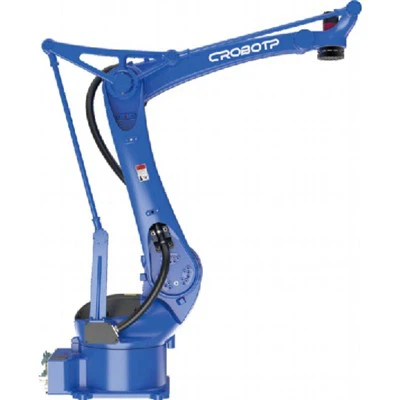
Product Introduction
The CRP-RA28-360 is a six-axis industrial handling robot designed for heavy workpieces and material-transfer operations. With a maximum payload of 360 kg and a maximum reach of 2,771 mm, it supports handling, assembly, cutting, spot welding, marking, milling, and grinding applications.
Its floor-mounted configuration and high-capacity wrist specifications make it a candidate for heavy-duty production cells where workpiece weight, tool configuration, and workstation layout are key selection factors.
Technical Specifications
|
Parameter |
Specification |
|
Model |
CRP-RA28-360 |
|
Robot type |
Vertical articulated robot |
|
Degrees of freedom |
6 axes |
|
Maximum payload |
360 kg |
|
Maximum reach |
2,771 mm |
|
Repeatability |
±0.08 mm |
|
Robot body weight |
1,574 kg |
|
Installation mode |
Floor-mounted |
|
Noise level |
<80 dB(A) |
|
Electrical cabinet |
G15A |
|
Reserved I/O |
26-pin |
|
Reserved pneumatic connections |
2 × φ12 mm |
|
Body protection rating |
IP54 |
|
Wrist protection rating |
IP67 |
Axis Travel and Maximum Speed
|
Axis |
Travel Range |
Maximum Speed |
|
Axis 1 |
-180° to +180° |
90°/s |
|
Axis 2 |
-85° to +65° |
82°/s |
|
Axis 3 |
-75° to +160° |
82°/s |
|
Axis 4 |
-210° to +210° |
100°/s |
|
Axis 5 |
-125° to +125° |
100°/s |
|
Axis 6 |
-360° to +360° |
200°/s |
Wrist Load Parameters
|
Parameter |
Axis 4 |
Axis 5 |
Axis 6 |
|
Allowable torque |
2,060 N·m |
2,060 N·m |
1,060 N·m |
|
Allowable moment of inertia |
260 kg·m² |
260 kg·m² |
160 kg·m² |
Operating Environment
|
Parameter |
Specification |
|
Ambient temperature |
0–45°C |
|
Relative humidity |
35–85% RH, non-condensing |
|
Vibration |
Below 0.5 G |
|
Installation environment |
Keep away from flammable or corrosive liquids and gases, and sources of electrical interference |
Customization
A heavy-load robot needs to be evaluated as part of the complete workstation, not by payload alone. Share the following project information so the robot configuration and integration requirements can be assessed against the intended process.
|
Project Input |
What to Provide |
|
Workpiece |
Maximum weight, dimensions, shape, and pickup points |
|
End-of-arm tooling |
Gripper or process-tool type, weight, dimensions, and center of gravity |
|
Wrist loading |
Tool and workpiece load distribution, including inertia information where available |
|
Work envelope |
Pickup and placement coordinates, required orientations, and station layout |
|
Process |
Handling, assembly, cutting, spot welding, marking, milling, or grinding |
|
Production target |
Required cycle time, transfer sequence, and operating schedule |
|
Cell interfaces |
Fixture arrangement, pneumatic requirements, I/O signals, and related equipment |
|
Site conditions |
Installation space, floor and foundation details, and environmental conditions |
Discuss Your Heavy-load Automation Project
Manufacturing and Quality Verification
CRP's company-level manufacturing and inspection capabilities provide the production background behind its industrial robot range.
- Integrated production: CRP reports a manufacturing base of more than 30,000 m², with processes covering core-component production, robot assembly, robotic dressing installation, and robot testing.
- Pre-shipment performance checks: CRP describes testing that includes repeated positioning accuracy and load-operation stability.
- Engineering and project support: CRP provides technical consultation and project-planning support for robot selection and automation integration.
These are company-level capabilities. Acceptance criteria for a specific CRP-RA28-360 project should be defined according to the application, tooling, and agreed technical requirements.
FAQ
Q: Is the 360 kg payload the total weight of the workpiece and gripper?
A: The robot's payload rating is a key selection limit, but the complete wrist load must also meet the applicable torque and moment-of-inertia limits. Provide both the workpiece and end-of-arm tooling details for configuration assessment.
Q: Does a 2,771 mm reach mean the robot can access every point within that distance?
A: No. Actual accessibility depends on the robot's working envelope, joint travel, tool orientation, base position, and surrounding fixtures. Review the working-range and motion-range diagrams during layout planning.
Q: Can this robot be used for grinding or spot welding?
A: These processes are listed among the model's applications. Suitability for a particular process depends on the tooling, wrist loading, process requirements, and overall cell configuration.
Q: What should be checked before selecting an end-of-arm tool?
A: Check the tool and workpiece weight, center of gravity, dimensions, required orientation, allowable wrist torque, and moment of inertia. The gripper or process tool must fit the robot's load limits and the intended motion.
Q: What installation conditions should be considered?
A: The listed installation mode is floor-mounted. The site review should cover the installation footprint, foundation and floor conditions, operating envelope, nearby equipment, and access for maintenance.
Q: Can the robot configuration be customized?
A: CRP lists options such as cable length, transformer power, teach-pendant configuration, interface language, and color. Other project-specific requirements should be discussed with CRP to establish what is supported for the intended application.
Q: What information is needed for a project quotation?
A: Provide the workpiece weight and dimensions, tooling details, application process, required reach and motion, target cycle time, workstation layout, and relevant electrical or pneumatic interfaces. This information helps CRP assess the proposed robot configuration and integration scope.
Hot Tags: high-load handling robot, China high-load handling robot manufacturers, suppliers, factory