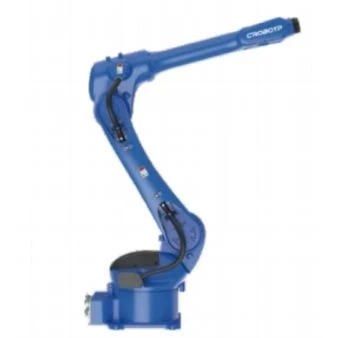
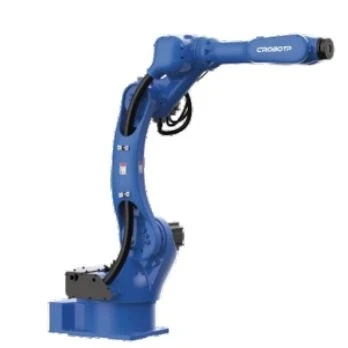
Product Overview
The Laser Seam Tracking Robot is designed for automated laser welding where the actual weld joint may deviate from its programmed trajectory. During welding, seam-tracking data helps the robot adjust its movement to follow the detected joint, supporting more consistent weld placement when part positioning or assembly conditions vary.
Unlike a vision-guided welding system focused on locating workpieces and establishing robot paths, this solution emphasizes tracking the actual seam and correcting the welding trajectory as the robot moves. Its six-axis motion and coordinated laser welding functions support integration into automated welding cells for suitable joint types and production requirements.
Key Features
Real-Time Weld Seam Tracking
Seam-tracking sensors detect the actual weld joint and provide positional data for the robot's tracking process. This allows the welding trajectory to respond to detected seam locations instead of relying exclusively on the original programmed path.
Adaptive Path Correction
When workpiece positioning, assembly tolerances or fixture alignment cause the actual seam to differ from the expected trajectory, tracking data can be used to adjust robot movement. This helps reduce the need for repeated manual path adjustments, provided the deviation remains within the system's tracking capability.
Dynamic Seam Start and End Detection
For supported joints, seam detection can help identify the actual welding start and end positions. This is useful when seam locations or lengths vary between workpieces and the welding sequence needs to respond to detected joint boundaries.
Tracking Along Curved and Complex Seams
Six-axis robot movement supports welding along suitable curved, angled and spatially changing joint paths. Actual tracking performance depends on seam accessibility, sensor visibility, joint geometry and the selected tracking equipment.
Coordinated Laser Welding and Wire Feeding
The robot's laser welding interface supports coordination of welding-related functions, including laser power control and wire-feeding operations. Supported functions include soft start and stop, pre-welding laser emission and power decay, wire-sticking detection, pre-wire extraction and wire replenishment. Servo or stepper motor control can be used for compatible wire-feeding equipment.
Flexible Robot Movement and Installation
With a 12 kg payload, 1510 mm reach and ±0.05 mm repeatability, the robot supports a range of laser welding cell layouts. Floor, inverted and side installation options provide flexibility for different equipment arrangements, subject to the applicable mounting and motion limits.
Technical Specifications
Robot Performance
|
Parameter |
Specification |
|
Number of Motion Axes |
6 |
|
Maximum Payload |
12 kg |
|
Maximum Reach |
1510 mm |
|
Repeatability |
±0.05 mm |
|
Installation Options |
Floor, inverted, side |
|
Robot Body Protection |
IP54 |
|
Wrist Protection |
IP67 |
|
Robot Weight |
170 kg |
Joint Motion Range
|
Axis |
Motion Range |
|
J1 – Floor / Inverted |
-167° to +167° |
|
J1 – Wall Mounting Range |
-30° to +30° |
|
J2 |
-155° to +90° |
|
J3 |
-85° to +155° |
|
J4 |
-190° to +190° |
|
J5 |
-105° to +130° |
|
J6 |
-210° to +210° |
Maximum Joint Speed
|
Axis |
Maximum Speed |
|
J1 |
169°/s |
|
J2 |
169°/s |
|
J3 |
169°/s |
|
J4 |
301°/s |
|
J5 |
220°/s |
|
J6 |
743°/s |
Wrist Load Limits
|
Parameter |
J4 |
J5 |
J6 |
|
Allowable Torque |
20 N·m |
20 N·m |
11 N·m |
|
Permissible Moment of Inertia |
0.5 kg·m² |
0.5 kg·m² |
0.16 kg·m² |
Operating Conditions and Interfaces
|
Parameter |
Specification |
|
Operating Temperature |
0–45°C |
|
Relative Humidity |
20–80%, non-condensing |
|
Body Interface |
16-pin, 2 × Φ8 mm |
|
Power Input |
Single-phase 220 V |
Applications
Laser seam tracking is suited to automated welding processes where the actual joint position may vary and the selected tracking system can reliably detect the seam.
- Automotive components: Welding suitable metal components where assembly variation can affect joint position.
- Sheet metal parts: Following seams on fabricated panels and formed metal parts.
- Metal enclosures and cabinets: Tracking accessible joints across enclosure sections and structural panels.
- Curved metal structures: Following suitable curved or spatially changing seams.
- Industrial equipment components: Automating repeatable welding operations on metal assemblies.
- Automated laser welding cells: Integrating seam tracking into robotic production systems that require in-process path correction.
Customization and System Integration
Each application should be assessed around the actual weld joint and the production process. Relevant factors include sensor mounting and viewing angle, seam accessibility, laser welding equipment, wire-feeding requirements, robot reach, fixture layout, cable routing and the required welding sequence.
CRP can support project discussions covering robot selection, system integration, customization requirements and the production cell layout. Final system design depends on the workpiece, weld path, process equipment and automation objectives.
Discuss Your Laser Welding Project
Manufacturing, Quality and Technical Support
CRP combines robot manufacturing with in-house development of robot control systems, supporting industrial automation projects that require coordinated robotic motion and equipment integration.
- Manufacturing capability: A manufacturing base of more than 35,000 m² supports robot production and related automation equipment.
- Quality management: Quality controls cover incoming materials, dimensional inspection, component checks, load aging and final inspection.
- Installation and training: Available project support includes installation, commissioning, troubleshooting, and training in robot operation, programming and maintenance.
- After-sales support: CRP publishes a two-year robot warranty, repair support for up to five years after product discontinuation, and replacement support for up to ten years, subject to the applicable service terms.
FAQ
Q: Does laser seam tracking eliminate the need for precision fixtures?
A: Not necessarily. Seam tracking can compensate for detectable joint-position deviations within the capabilities of the selected system, but fixtures are still important for workpiece stability, repeatable presentation and safe operation. Excessive displacement, poor seam visibility or inconsistent part geometry may exceed the available tracking range.
Q: Which weld joints are suitable for laser seam tracking?
A: Suitability depends on the joint profile, seam accessibility, surface condition and whether the tracking sensor can detect the joint reliably. Straight, curved and spatially changing seams may be suitable when the selected sensor and tracking method support their geometry. The actual workpiece and weld path should be assessed during project planning.
Q: What happens if the actual seam deviates from the programmed path?
A: The tracking system detects the seam position and provides data that can be used to correct the robot's trajectory during the welding process. The amount and speed of correction depend on the sensor, controller, robot motion, weld geometry and operating conditions. Deviations outside the supported tracking range may still require process or fixture adjustments.
Q: What information is needed to assess a laser seam tracking project?
A: Useful information includes workpiece drawings or samples, material and thickness, joint type, seam length and geometry, expected part-position variation, required welding sequence, laser equipment details, wire-feeding requirements and production targets. These details help determine sensor placement, robot reach, tracking suitability and integration requirements.
Hot Tags: laser seam tracking robot, China laser seam tracking robot manufacturers, suppliers, factory