Product Overview
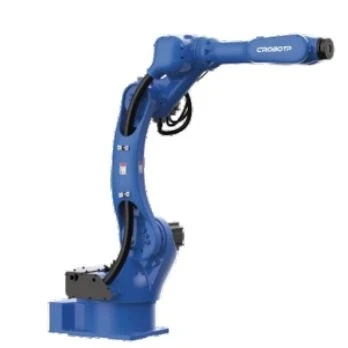
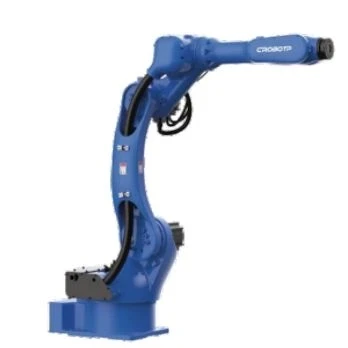
The 6000W+ Robotic Laser Welding System combines six-axis robotic movement with dedicated laser welding control for automated metal fabrication. With a maximum reach of 2015 mm, a 12 kg payload, and integrated laser and wire-feeding functions, it supports programmed welding paths for suitable stainless steel and aluminum alloy components.
The system is suited to production environments that require multi-directional weld access, coordinated process control, and flexible welding-cell layouts.
Key Features
Coordinated Laser and Wire-Feeding Control
The dedicated welding interface supports laser power modulation, soft start/stop, pre-laser emission and decay, wire-sticking detection, pre-feeding, and wire replenishment. These functions coordinate key process actions along programmed welding paths.
Six-Axis Access to Complex Weld Joints
Six-axis movement and a maximum reach of 2015 mm support welding paths across different workpiece surfaces and orientations, subject to fixture placement and tool access.
Flexible Filler-Wire Delivery
The wire-feeding system supports servo- or stepper-motor control and welding wire diameters from 0.6 to 2.0 mm, providing options for suitable filler-wire applications.
Repeatable Robot Positioning
The robot has a specified repeatability of ±0.08 mm, supporting consistent execution of programmed paths across repeated production cycles.
Compact Control Cabinet
CRP's compact electrical cabinet design supports space-conscious integration with compatible laser-processing equipment.
UPS Power Protection
An integrated UPS provides a switching time of no more than 5 ms during power interruptions, helping protect the robot control equipment.
Technical Parameters
Robot and System Specifications
|
Parameter |
Specification |
|
Product type |
Robotic laser welding system |
|
Laser output power |
6000W+ |
|
Number of motion axes |
6 |
|
Maximum payload |
12 kg |
|
Maximum reaching distance |
2015 mm |
|
Repeatability accuracy |
±0.08 mm |
|
Robot body weight |
170 kg |
|
Installation methods |
Floor, inverted, and side mounting |
|
Robot body protection rating |
IP54 |
|
Robot wrist protection rating |
IP67 |
|
Operating temperature |
0–45°C |
|
Relative humidity |
20–80% RH, non-condensing |
|
Body interface |
16-pin interface; 2 × Ø8 mm ports |
|
Robot power input |
Single-phase 220V |
|
UPS switching time |
≤5 ms |
|
Welding wire diameter |
0.6–2.0 mm |
|
Wire-feeding control |
Servo or stepper motor |
Joint Movement and Performance
|
Parameter |
J1 |
J2 |
J3 |
J4 |
J5 |
J6 |
|
Maximum angle |
Floor/inverted: −167° to +167°; side: −30° to +30° |
−50° to +170° |
−8° to +155° |
−190° to +190° |
−135° to +135° |
−210° to +210° |
|
Maximum speed |
170°/s |
170°/s |
200°/s |
350°/s |
350°/s |
540°/s |
Allowable Torque and Moment of Inertia
|
Parameter |
J4 |
J5 |
J6 |
|
Allowable torque |
40 N·m |
40 N·m |
13 N·m |
|
Permissible moment of inertia |
1.3 kg·m² |
1.3 kg·m² |
0.43 kg·m² |
Applications
The system supports automated welding tasks involving suitable metal materials and workpiece geometries.
- Stainless Steel Fabrication: Frames, enclosures, and fabricated metal components.
- Aluminum Alloy Parts: Compatible components requiring programmed laser welding.
- Three-Dimensional Assemblies: Workpieces with weld joints across multiple surfaces.
- Repeat-Batch Manufacturing: Recurring welding operations using programmed robot paths.
- Automated Welding Cells: Production stations built around dedicated fixtures and workpiece positioning.
Adapt the Robot to Your Welding Cell
CRP offers robot-related options to accommodate installation layouts and operator requirements.
- Interconnection Cable: 5 m standard; 8 m, 10 m, and 15 m options, with other lengths available.
- Teach Pendant: Model E and Model C options.
- Teach Pendant Cable: 6 m, 8 m, 10 m, 12 m, and 15 m options; other lengths can be requested.
- Operator Interface: English interface options.
- Robot Color: Blue, telecom gray, red, yellow ASD, yellow FLK, signal white, grass paper, and light gray; other colors can be requested.
- Installation Layout: Mounting direction, cable routing, fixture access, and peripheral placement can be planned around the welding station.
Complete-cell planning can also account for the laser source, welding head, wire feeder, protective equipment, and required machine interfaces.
Discuss Your Robotic Laser Welding Project
Why Choose CRP for Robotic Laser Welding?
Robotics Development and Manufacturing
CRP has developed robot control systems since 2007 and established its robotics company in 2012. Its industrial robot manufacturing base covers more than 35,000 m² and supports the development and production of robots, controllers, drive systems, and control equipment.
Traceable Quality and Performance Testing
CRP's quality processes include incoming material inspection, dimensional measurement, QR-code traceability, and component inspection. Robot testing includes 24-hour maximum-load aging, positioning accuracy, noise, abnormal sounds, and electrical cabinet compatibility checks.
Technical Expertise
CRP holds more than 400 authorized intellectual property rights, including over 40 invention patents, covering areas such as robot control, drive systems, sensing technologies, and industrial robot development.
Installation and Long-Term Support
CRP provides installation guidance, commissioning assistance, technical troubleshooting, and robot operation, programming, and maintenance training. Published robot support terms include a two-year robot warranty, repair support for up to five years after product discontinuation, and replacement support for up to ten years. Laser sources and peripherals follow their respective warranty arrangements.
FAQ
Q: Can the system weld workpieces with different joint geometries?
A: Yes. The six-axis robot can follow programmed paths across different workpiece surfaces and orientations. Actual accessibility depends on joint location, fixture design, welding-head clearance, and the robot's working range.
Q: How are welding paths programmed for a new workpiece?
A: Welding paths are programmed according to the workpiece geometry and the required joint trajectory. Path planning needs to account for robot reach, tool orientation, fixture positions, and the sequence of welding operations.
Q: Can the robot work with a positioner or other workpiece-handling equipment?
A: A positioner or handling device can be considered when a workpiece needs to be rotated or repositioned during welding. Integration depends on the required motion coordination, control interfaces, workpiece dimensions, and the planned cell layout.
Q: How can a new welding application be evaluated before production?
A: Application evaluation should use representative workpieces or samples to assess weld appearance, joint formation, process stability, and compliance with the required acceptance criteria. Material grade, thickness, joint preparation, and laser process parameters all affect the result.
Q: What factors influence welding consistency between production batches?
A: Consistency depends on more than robot repeatability. Workpiece tolerances, fixture positioning, joint fit-up, material variation, welding parameters, and maintenance of the welding head and wire-feeding equipment can all affect the result.
Q: What safety measures are needed for a robotic laser welding cell?
A: The cell should be assessed for laser-radiation hazards, access control, protective enclosures, interlocks, emergency stops, and risks associated with robot movement. Fume extraction and other safeguards should be selected according to the material and welding process, with the completed installation assessed against applicable local requirements.
Q: Does the robot's repeatability specification represent the final welding tolerance?
A: No. The ±0.08 mm specification describes robot repeatability. Final weld results also depend on the laser process, workpiece positioning, fixture accuracy, material, and welding parameters.
Q: What equipment should be considered when planning a complete welding cell?
A: Planning should cover the laser source, welding head, wire feeder, workpiece fixtures, protective equipment, and interfaces with connected machinery. The required scope depends on the intended production process.
Hot Tags: 6000w+ robotic laser welding system, China 6000w+ robotic laser welding system manufacturers, suppliers, factory