

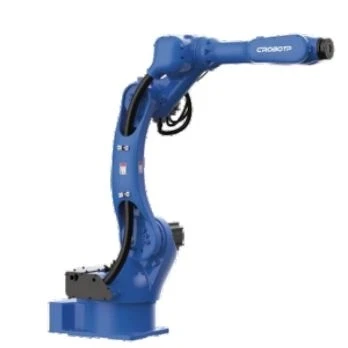
Product Overview
The 2000W / 3000W Laser Welding Robot combines a six-axis industrial robot with a dedicated welding process interface to automate metal joining on repeatable production runs.
Available in two laser power options, it can be assessed for applications involving different materials, thicknesses, and joint designs. Selection should also account for weld-quality targets, wire-feeding needs, seam accessibility, cycle time, and fixture layout.
Technical Parameters
Laser Welding System
|
Parameter |
Specification |
|
Product name |
2000W / 3000W Laser Welding Robot |
|
Laser power options |
2000W / 3000W |
|
Robot motion |
Six-axis |
|
Welding process interface |
Dedicated laser welding interface |
|
Wire-feeding control |
Dual servo and stepper motor control |
|
Supported wire diameter |
0.6–2.0 mm |
Robot Body Parameters
|
Parameter |
Specification |
|
Degrees of freedom |
6 axes |
|
Maximum payload |
12 kg |
|
Maximum reach |
1510 mm |
|
Repeat positioning accuracy |
/ |
|
Robot body weight |
170 kg |
|
Body protection rating |
IP54 |
|
Wrist protection rating |
IP67 |
|
Installation options |
Floor, inverted, and wall mounting, subject to permitted axis ranges |
|
Ambient temperature |
0–45°C |
|
Relative humidity |
20–80% RH, non-condensing |
Joint Motion and Speed
|
Joint |
Motion range |
Maximum speed |
|
J1 - floor or inverted mounting |
−167° to +167° |
169°/s |
|
J1 - wall mounting |
−30° to +30° |
169°/s |
|
J2 |
−155° to +90° |
169°/s |
|
J3 |
−85° to +155° |
169°/s |
|
J4 |
−190° to +190° |
301°/s |
|
J5 |
−105° to +130° |
220°/s |
|
J6 |
−210° to +210° |
743°/s |
Wrist Load Limits
|
Parameter |
J4 |
J5 |
J6 |
|
Allowable torque |
20 N·m |
20 N·m |
11 N·m |
|
Permissible moment of inertia |
0.5 kg·m² |
0.5 kg·m² |
0.16 kg·m² |
Functional Features
Integrated Welding Process Functions
The dedicated welding interface includes functions for laser power control, wire feeding, soft start and stop, pre-attenuation, wire-sticking detection, pre-drawing, and wire filling. These functions help coordinate the welding process with the robot's programmed movement.
Six-Axis Movement for Complex Weld Paths
The articulated arm can follow programmed paths around different sides and angles of a workpiece. This is useful for parts with seams on multiple planes, provided the welding head can access the joint and the path remains within the permitted working envelope.
Controlled Wire Feeding
Dual servo and stepper motor control supports welding wire diameters from 0.6 to 2.0 mm. Wire material, diameter, feed speed, and process settings should be selected according to the base material, joint design, and welding procedure.
Vertical Teach Pendant
The vertical teach pendant provides an operator interface for robot teaching and program operation. Programming time varies with seam complexity, workpiece geometry, fixture design, and operator experience.
Control Cabinet and Layout Options
Control cabinet selection and electrical arrangements should be considered alongside the laser source, welding head, cables, and other peripherals. Reviewing the available installation space and interface requirements early helps determine whether the proposed cell layout is practical.
Power-Interruption Protection
CRP's laser welding robot information describes a UPS transfer function with a stated switching response of no more than 5 ms. Its applicability to the selected product version and the scope of power protection should be established before this function is included in the final specification.
How to Choose Between 2000W and 3000W
Laser power affects the welding process, but it does not independently determine maximum weldable thickness, weld quality, or production speed. The appropriate option depends on the complete application.
|
Selection factor |
What to evaluate |
|
Material |
Material grade, surface condition, reflectivity, and compatibility with the selected laser source |
|
Thickness |
Actual material thickness and required weld penetration |
|
Joint design |
Joint type, gap tolerance, fit-up consistency, and seam accessibility |
|
Weld quality |
Required appearance, strength, penetration, distortion limits, and inspection criteria |
|
Production target |
Weld length, number of seams, cycle-time target, and operating schedule |
|
Workpiece access |
Part dimensions, fixture clearance, mounting position, and robot reach |
|
Filler wire |
Whether wire is required, including wire material and diameter |
Evaluate both power options using representative workpieces and the intended welding procedure. Maximum thickness and achievable cycle time should be established through application testing rather than inferred from laser power alone.
Applications
Robotic Laser Welding for Fabricated Metal Parts
This solution can be evaluated for repetitive metal-joining tasks where the workpiece can be positioned consistently and the required seams are accessible to the robot.
- Sheet-metal parts: Panels, brackets, and formed components with defined, repeatable seams.
- Metal enclosures and cabinets: Fabricated housings and enclosure panels requiring consistent weld paths.
- Stainless-steel products: Components where the selected alloy, joint geometry, and surface-finish requirements are suitable for laser welding.
- Aluminum components: Parts requiring application-specific assessment of alloy, thickness, joint preparation, and welding parameters.
- Industrial metal assemblies: Repetitive fabricated assemblies with fixed joint locations and suitable fixture access.
Customization and Project Integration
CRP offers robot-level options for industrial automation projects. For a laser welding application, the supply scope should be defined according to the selected robot, laser equipment, welding head, wire feeder, fixtures, control interfaces, and production-line requirements.
Available options and project considerations include:
- Interconnection cable length: 5 m standard, with 8 m, 10 m, and 15 m options.
- Teach pendant: Model E and Model C options.
- Teach pendant cable: Options include 6 m, 8 m, 10 m, 12 m, and 15 m.
- Control interface: English interface and screen-label options.
- Robot color: Standard color options, with custom colors available subject to project arrangements.
- Project development: Application evaluation, conceptual design, material preparation, production, performance testing, and sample completion.
Availability depends on the selected product and project scope. Robot-level customization does not automatically mean that the laser source, welding head, wire feeder, safety devices, or all peripheral equipment are included in the supply.
Discuss Your Customization Requirements
Why Work with CRP
Industrial Robot Development and
Manufacturing
CRP develops and manufactures industrial robots and core robot components. Its published company information reports a manufacturing base of more than 35,000 m², over 300 employees, and more than 400 authorized intellectual property items, including over 40 invention patents.
Options for Project-Specific
Requirements
Robot-level options cover cable lengths, teach pendants, control interfaces, and appearance. These choices can help align the robot with installation constraints and operating requirements.
Overseas Project
Support
CRP serves overseas markets through international sales and distribution resources. Depending on the project and service arrangement, support may include application discussions, installation guidance, commissioning, operation training, and maintenance assistance.
FAQ
Q: What should be checked before installing the robot in a production cell?
A: Review the available floor space, robot mounting position, workpiece loading and unloading access, fixture clearance, cable routing, and required safety measures. The planned weld paths should also be checked against the robot's working envelope before the cell layout is finalized.
Q: How can welding quality be evaluated before production starts?
A: Run welding trials using representative workpieces and the intended joint preparation, materials, and process settings. Inspect the resulting welds against the project's acceptance criteria, including appearance, penetration, strength, and any applicable inspection requirements. Trial results can help establish process settings before repeat production begins.
Q: What should be considered when changing to a different workpiece?
A: A new workpiece may require updated robot paths, fixture positioning, welding parameters, and wire-feeding settings. Before switching production, check that the new part remains within the robot's reach and that the welding head can access every required seam. The amount of reprogramming and validation depends on the differences between the parts and their joint designs.
Hot Tags: 2000w / 3000w laser welding robot, China 2000w / 3000w laser welding robot manufacturers, suppliers, factory


